
Contrary to recent popular opinion, not all indoor air quality complaints are related to mold. And not all allergy complaints are related to mold. Furthermore, not all complaints are associated to a single source.
We identify and isolate all, not just one, likely sources of building-related health complaints in a focused, cost-effective manner. Our approach minimizes expensive generic air sampling and analysis. In some cases, given a logical conclusion to obvious discrepancies, air sampling may be avoided entirely. Experience speaks volumes when solving complex challenges.
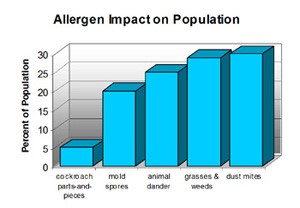
Frequently encountered allergens in the U.S. population. Note that dust mite allergens are 50% more likely to affect our population than are mold spores.
Investigative Approach to IAQ
Documents Review
A documents review provides basic information about the occupied areas, complaints, and known chemicals encountered in the facility. The questionnaires should be passed out to all occupants—complainants and non-complainants.
- Blueprints
- Occupant questionnaires
- Chemical SDSs available
Building Walk Through
A walk-through of the occupied areas can lead to observations regarding discrepancies such as a collapsed air return filter full of dirt and debris. For instance, we encountered an isolated air return filter that had not been changed for years. It was shredding and dust and debris in an office space.
Once again, we have found that, especially in large office buildings, there are “multiple and different” sources related to poor indoor air quality. During a walkthrough we can generally identify multiple problem areas and forgo extensive air sampling.
- Review occupied areas
- Inspect air handling systems
- Inspect bathroom exhausts
- Inspect plumbing
Observations Part of the Walk Through
Surprisingly, an item that is often missed is bathroom exhausts where the fan is either not working, inadequate, or reversed directional air flow back into the bathroom. P-traps under sinks, showers, and air handler drain pan plumbing may be clogged or non-existent.
Activities can be suspect during a walk-through. In one case, carbon monoxide gas was getting into the plumbing system, the source being the exhaust from the capture system in an automotive shop which was located next door.
The list of possibilities is endless. Observations are highly relevant. As checklists can be distracting, we do not use checklists. We use our expertise and knowledge of building systems and components and human health concerns.
- Area and activities exterior to the building
- Septic fields in rural environments
- Vegetation in and around the building
- Underground structures
Interviews of Facility Personnel
Facility personnel are often a great source of information. The maintenance staff generally has some ideas as to the source of the problem(s). And the custodial staff may be performing some evening activities that are affecting the air quality. For instance, we observed the evening crew emptying their vacuum debris in the same area every night. It so happened that that location was in an area where there was a complaint about excessive dust and coughing in the morning.
- Maintenance personnel
- Custodial
Interview Complaint and Non-Complaint Occupants