
Noise Level Examples & OSHA Limits
Noise Trivia
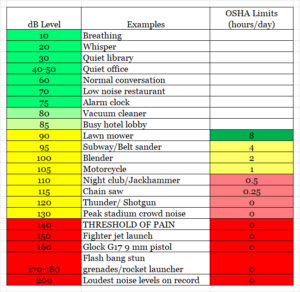
The loudest noises are created by the animal kingdom. As they click, roar, snap, and howl when looking for food, mates, calling their young, self-defense, and direction. The blue whale—the largest animal on earth just happens to be the loudest animal on Earth. Topped at 188 decibels (dB), they make pulses, groans, and moans that can be heard up to 1,000 miles away. As a comparison, a jet engine ranges from 120 to 140 dB at 40 feet from the jet.
On the other hand, a sperm whale is louder yet at a lower frequency that is not heard by most humans. It communicates locally at 240 dB. Although humans cannot hear most low frequencies, a level of 240 dB physically uncomfortable to man.
The snapping shrimp can create a popping sound as loud as 200 dB which can stun or kill its prey. They use their giant claws to create bubbles that can stun or kill prey, deter predators, and attract mates.
The howler monkey has been recorded at 140 dB, and the bulldog bat produces high frequency cries up to 140 dB. The impact of proximity to and frequency of loud noises from the wild is unclear. At extreme frequencies, you may be physically impacted.